
By Mary Cloud, Development Director, River Bridge Regional Center
The way we respond to a child’s disclosure of abuse can significantly impact their emotional and physical well-being for years to come. When caregivers and professionals respond with belief, support, and appropriate action, it can significantly aid the child’s recovery and resilience.
Here is a story about a young boy who was referred to the child advocacy center, River Bridge Regional Center (RBRC), by law enforcement and child protection, due to reports that he had been inappropriately touched by an older male acquaintance. We emphasize the crucial need for educating our community on the best practices for responding to a child’s disclosure and the benefits of evidence-based therapy in promoting hope and healing.
It is not often that children immediately tell about abuse. There are many valid reasons for this, which can be saved for another article. However, this child confided in his parents and the family took immediate action in contacting the appropriate authorities (law enforcement and human services) to seek help in navigating this distressful and often-scary situation. This empathetic approach helped build trust and empowered the young boy to feel valued and heard.
Upon coming to River Bridge Regional Center (RBRC), the young boy talked with our forensic interviewer. The forensic interview was the opportunity for the boy to tell for the first time the extent of his abuse. During this time, the family member, with the help of the family advocate, completed a mental health screener tool, adapted from the Pediatric Symptom Checklist. This screener tool indicated that the young boy had a significant need for mental health therapy.
The parent and the young bog first met with one of our clinicians to build rapport and to get to know them. This discussion helped the clinician to decide which evidence-based assessment was the right fit for the age of the boy. The findings from our client’s initial assessment, data shown in the graph in blue, reveal that the boy scored clinically significant (above 70) on 6 out of the 9 measures expressing a variety of symptoms relating to trauma.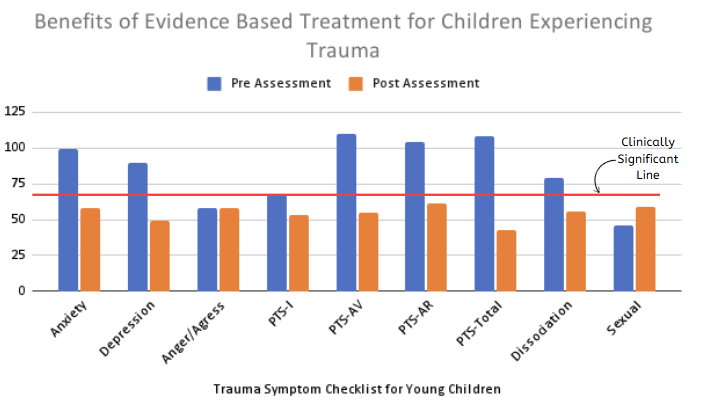
After the initial assessment, the young boy participated in evidence-basedtherapy called Trauma-Focused Cognitive Behavioral Therapy (TF-CBT) with one of our clinicians. This treatment spanning 16 sessions, involved the child, his supportive parent and clinician. Initially, the boy and his parent had separate therapy sessions, which then gradually progressed to joint sessions. Cognitive behavioral techniques were employed to help reshape the child’s distorted or unhelpful thoughts, as well as to address behaviors which were interfering with the child’s success at school and in relationships with his family.
The child’s final assessment, which the caregiver completed after he finished TFCBT, represented by the data in orange, indicated that the need for continued therapy was no longer. His scores were below the clinically significant threshold (under 70) across all measures! Amy Gomez, RBRC Mental Health Clinician and Prevention Coordinator states, “Children show greater resilience in overcoming trauma when they have a trusted confidant who believes in and supports them.” This child’s journey not only highlights the effectiveness of evidence-based treatments but also emphasizes the vital role of a supportive parent in the healing process. At the conclusion of therapy, the achievements of the child, their non-offending caregiver were celebrated with treats and lots of praise. Hooray!
River Bridge receives referrals for nearly 200 children each year. We also understand that those whose abuse has been reported and who have engaged with us through the Department of Human Services or Law Enforcement have the potential to heal and recover. The collaborative efforts between River Bridge, law enforcement, and child protection services demonstrate the power of a multidisciplinary approach in safeguarding the well-being of children. As we continue to implement evidence-based therapies, we pave the way for more children to overcome their past traumas and look forward to a brighter, healthier future.
River Bridge Regional Center is a nationally accredited nonprofit child advocacy center, utilizing a child-centered, multidisciplinary approach to the prevention, assessment, and treatment of child abuse in order to provide hope and healing to neglected and abused children and their non-offending family members. RBRC serves Eagle, Garfield, Pitkin, and Rio Blanco counties in Colorado. To learn more about RBRC, including education prevention for children and families, special events, or to donate, please visit www.riverbridgerc.org. If you are concerned about a child, please make a report to the Colorado Child Abuse Hotline, 1-844-CO4-KIDS, (1-844-264-5437).


 English